CLICK HERE to go back to HOME PAGE

Data modes operation

A quick way to check out digital modes within Amateur Radio is to go no far than look at the excellent website of G4UCJ. (Sean). Sean has a page which goes into great detail on all aspects of data modes on HF bands.

G4UCJ Data Modes CLICK HERE

I have put together below the areas that I enjoy and have had most success with over my short spell as a Ham Radio enthusiast.

PSK31 is a highly-efficient data mode that lets you work long distances, even when you can barely hear the signal. PSK31 stands for Phase Shift Keying 31 baud (or 31 bits per second/bps). Unlike RTTY (radio teletype) the characters are formed by changing the phase of the sound wave, not by using different tones. A PSK31 signal just sounds like a single tone or note with a slight wobble and is used for real-time keyboard-to-keyboard informal text “chats” over the air.

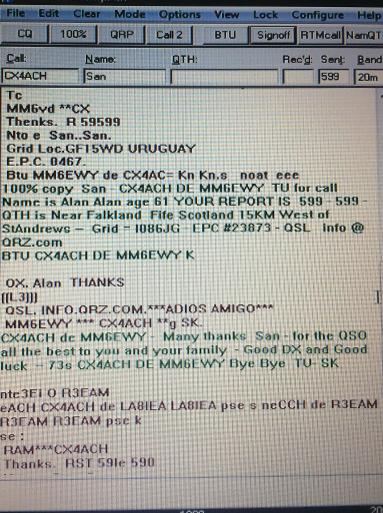
On the right is a screenshot from my PSK31 contact with CX4AC.

As you can see I was MM6EWY when the contact was made. I would be using power between 5 to 10 watts due to licensing restrictions.

Data modes are ideal for M6 foundation licence holders due to their licence restrictions.

HF PSK31 Frequencies Amateur Band USB Dial Frequency

160 metres 80 metres 40 metres 30 metres 20 metres 17 metres 15 metres 12 metres 10 metres
1838.150 kHz 3580.150 kHz 7040 kHz and up 10142.150 kHz 14070.150 kHz 18100.150 kHz 21080.150 kHz 24920.150 kHz 28120.150 kHz

 WSJT - JT65

JT65 is one of the more specialist data modes that I’ve played with, but I must admit, it’s quite addictive. As with modes such as PSK31 and WSPR, you interface your HF rig to a computer, and send out text encoded by your computer over the amateur bands. With JT65, you’re restricted to very small messages, with a limit of 13 characters per message.

Each message of up to 13 characters is sent over the course of 50 seconds, starting at the top of each minute, so the above conversation would take six minutes. One person sends on the odd minute, and the second person sends on the even minute. JT65 handles very weak signals, just like WSPR, so will get through where voice and PSK31 won’t. You can also use the great online PSK Reporter website to see where your JT65 CQ calls are reaching, making it great for checking your antenna’s performance.

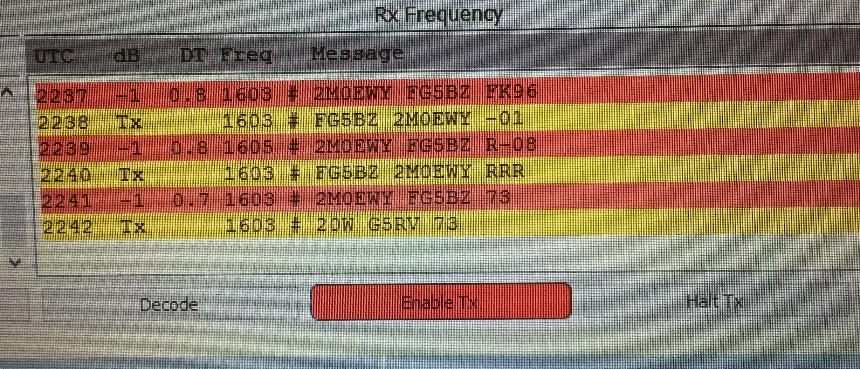
Below a screenprint of a QSO with FG5BZin GUADELOUPE
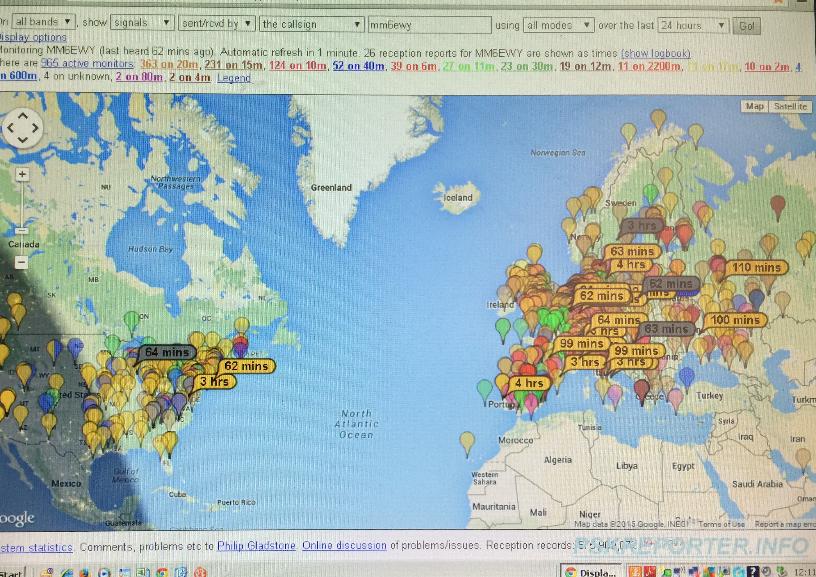
Below is a screenprint of 24 hrs on 20M JT65

followed by a print of one CQ CQ transmission on PSK31 on 20M and 15M

Similar maps are available for PSK31/63 etc

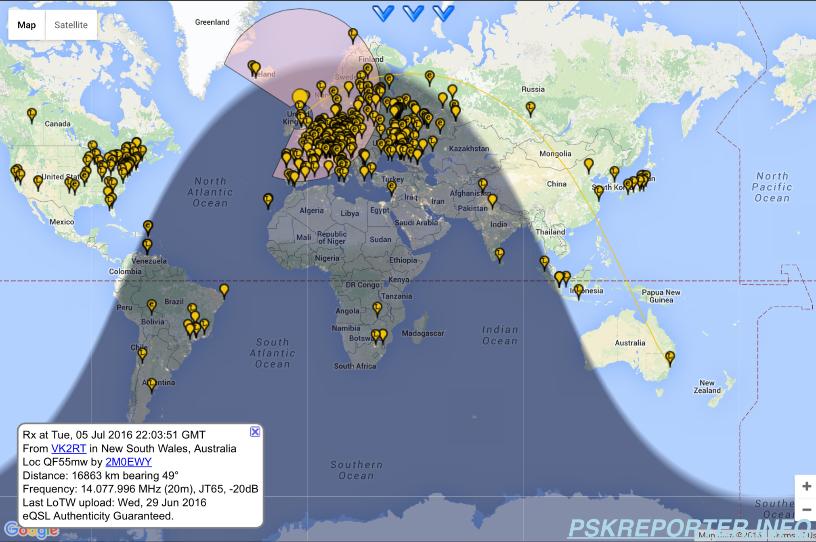
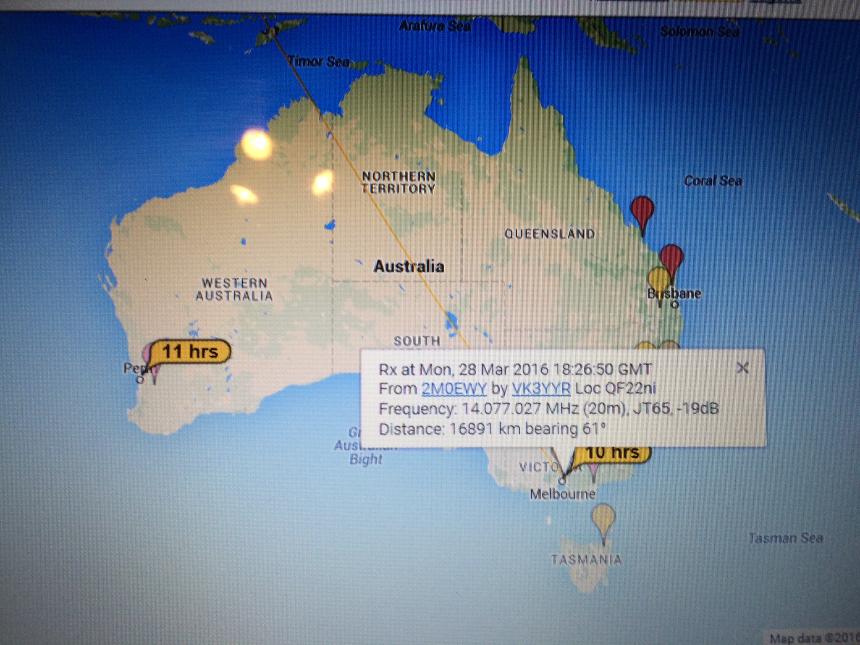
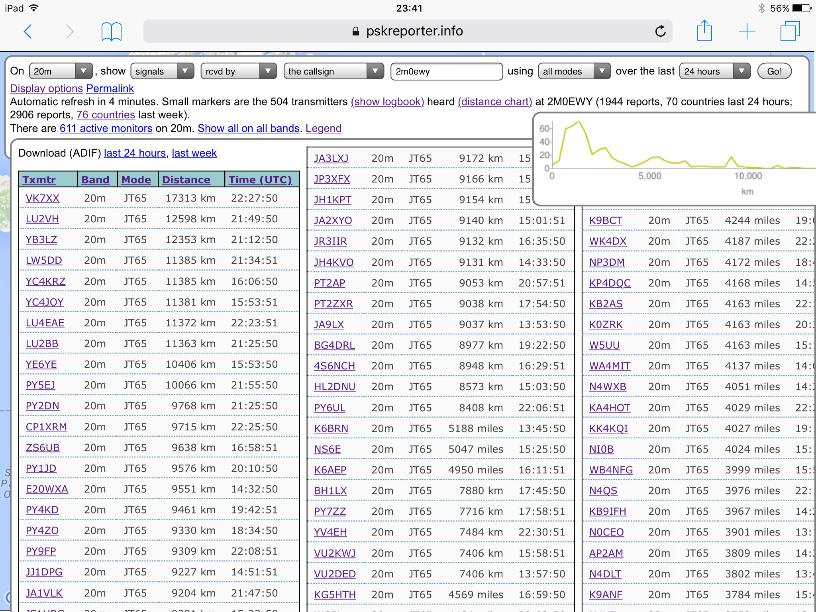
Below is a screenprint of transmissions from 2M0EWY 10w Full Size G5RV running East to West 

24 Hr logbook of JT65 July 2016